
Can underwater photogrammetry provide an accurate, non-invasive way to monitor the health of protected marine species? How can citizen science become an active component to monitoring the health of our reefs?
This is the question Team BioClutter is exploring during a survey of Southern Sea Fans (Eunicella verrucosa) around Lundy Island. Using nothing more than a GoPro camera and photogrammetry software, the team created detailed 3D models of individual sea fans. This data can be measured, revisited, and compared over time.
The project successfully produced 11 photogrammetric models, demonstrating that underwater photogrammetry can capture detailed, repeatable records of fragile marine habitats without physically handling the organisms. By creating accurate digital records, researchers can monitor changes in colony size and condition while minimizing disturbance to the reef.
- 11 sea fan colonies successfully reconstructed
- Captured using a GoPro
- Non-invasive workflow
- Repeatable measurements
- Supports long-term marine monitoring
About Tim and His Research
In this guest blog, underwater photographer and diver Tim Clements explains the survey methodology, the imaging workflow, the challenges of working underwater, and how photogrammetry is becoming an increasingly valuable tool for marine conservation and citizen science.
Underwater Sea fan Photogrammetry Survey techniques continue to expand the role of underwater photogrammetry in marine conservation, reef health monitoring, and citizen science diving projects. In this guest blog, technical diver, educator, and photogrammetry specialist Tim Clements explores how compact GoPro based imaging systems can support more precise sea fan survey methods while reducing physical contact with delicate marine environments. Drawing from fieldwork conducted during the Lundy Marine Festival, Tim examines how 3D marine documentation and reef photogrammetry may offer new opportunities for underwater habitat monitoring and diver led scientific recording.
However, for those of you who don’t like reading to the end, love spoilers and need to crack on with some actual diving, here’s an executive summary….
Underwater Sea fan Photogrammetry Survey
During the Lundy marine festival in 2022, my buddy and I were tasked with some Sea fan surveying on our last dive. But, we skipped the usual method, opting for a photogrammetry model from gopro stills. However, this worked out pretty well and there seems to be potential for this technological advance offering some new insights over the traditional methods. Obviously, there are also some drawbacks, but for more detail and discussion you’ll need to put the kettle on and read the whole thing. Because I’ll try and make it worthwhile.
After that flashforwards, let’s rewind and do this properly. I’m Tim Clements – I’ve been intrigued by photogrammetry for divers since 2016 and was part of the team that wrote the IANTD speciality in 2017. I’m especially intrigued by how much can be accomplished by divers with small easy to carry gopro rigs, which fits in with another interest, citizen science for divers. You might have read the previous blog on volume calculation for troublesome marine shapes, specifically the bryozoan Pentapora. That was actually inspired by this experience with sea fans, so if you’re a fan of reading things in canon order, head there next.
Marine Conservation
Previously, back in 2022, there were a few projects during the four days of diving that I managed on Lundy during that summer. The main project was a model of the protected wreck Iona II, but that’s another tale. There was also a survey of a sunken cannon, but that’s a fairly straightforward story. I also ran a trial on colonies of the sunset cup coral, Leptosamnia – that all needs a bit more processing and work, but should be another blog sometime.
Citizen Science and Underwater Reef Photogrammetry
Indeed, this particular exercise was the final dive of that programme. We had been looking unsuccessfully for cup corals on Pete’s pinnacle, a spectacular wall dive on the north end of the island. Dive two that day was on Brazen Ward, a zone between about 15m and 21m halfway down the East side. We were asked to look for Southern sea fans, Eunicalle verrucosa. These are a Mediterranean species near the Northern limit of their range at this point. The sea fan is a colonial, slow growing soft coral which acts as an indicator of reef health – if these can survive to a good size, then the site isn’t being disrupted too much. The East coast of Lundy is the original UK MPA, so they should be flourishing…. unless other pesky climate factors or physical disruption are at work!
3D Sea fan survey and Coral Health
Given that the growth and health of reefs has been studied over the years with a strong contribution from diving citizen scientists. The method has been to carry a ruler or tape, pencil and slate, recording the height and width, plus an estimate of ‘overgrowth’ by other marine life (algae, hydroids, dogfish eggs etc). That estimate of overgrowth is analogous to ‘health’. The drawbacks here are the faff of carting pencils, slates and rulers about, maintaining good buoyancy close to the sea fan, plus not breaking them. The sea fans are delicate and conservation really isn’t helped by knocking them over. They’re also complex shapes – sometimes it’s not quite clear, or a least subjective what the widest / tallest point might be, or how much overgrowth there is – and good science aims to reduce subjectivity.
Using GoPro Photogrammetry for Reef Monitoring and Citizen Science
Indeed, my reasoning was that this data could be collected in a better way. A revelatory experience with a gopro 10 earlier in the year had demonstrated an possible 0.1mm per pixel resolution. I figured this might just work our well for a sea fan with elements that were only 6-8mm in diameter – it might be possible to make a model without ‘webbing’. So instead of collecting pencils and ‘stuff’ I headed in with my gopro, a scale bar and some compact video lights. Still ‘stuff’ but hopefully yielding more quantitative results.
Reef Health documentation at Lundy
The initial part of the dive didn’t offer any potential. Not a sea fan to be seen at 15m. However, at 18m, here was one! Small and spindly, but certainly a candidate for a trial. I unfolded the lights, popped down the scale bar, had a one minute spiral zip around with the camera set to interval shoot once per second and that seemed to be that. James hooted through his loop that he had found another, then another. We circled away feeling very pleased.
Challenges During with GoPro photogrammetry
However, the only slight drawback was the moment when manoeuvring seemed a bit tricky. I felt that James Gregorys’ loop laughter was a bit much, but it transpired later that the difficulties all stemmed from a seal trying to make off with my fin. Finning is much more sluggish when there’s an extra 200kg attached. James was even good enough to make a short video using his own gopro. Bless. Here it is!
Our dive time was pretty much done, and concluded our Underwater Sea fan Photogrammetry Survey. We had spent 30 mins looking for sea fans and 20 mins sampling. On top of our earlier 38m dive, even the rebreathers were indicating that deco was needed. Off we went for a great following sea ‘surf’ back to Ilfracombe.
Processing Underwater Models in 3D Zephyr
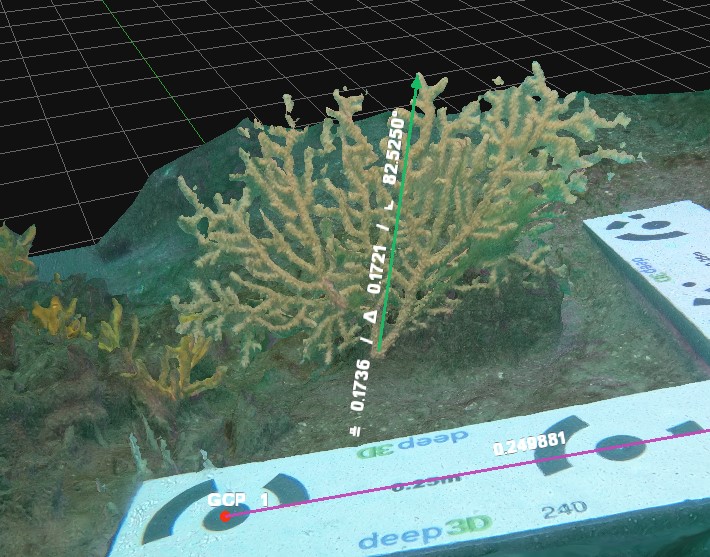
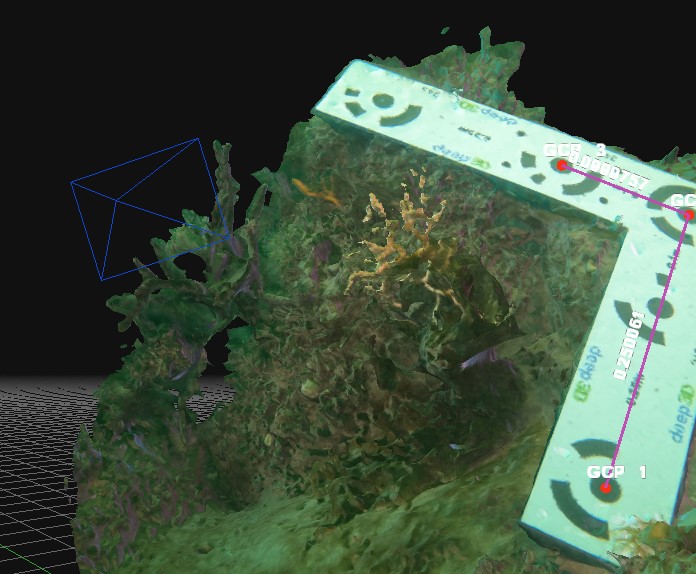
Back home, I separated the stills into models and hit go on the 3D Zephryr. 11 sets of photos yielded 11 models – a promising start. Webbing was minimal and several were really pleasing quality. None had been demolished during the survey. How the seal felt about this I have no idea. A quick chat with Simon Brown and scaling was applied, allowing the width and height to be measured much more accurately than with a ruler.
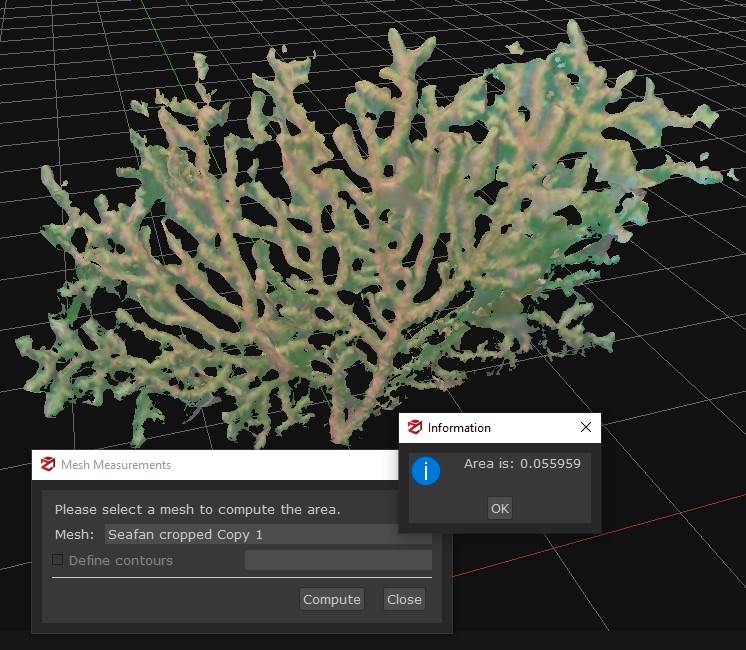
Simon also started saying exciting things about being able to calculate volumes, choosing pixel colour as a guide. This directly relates to the previous measurement of ‘health’ as a normal pink sea fan is ‘pink’ while the overgrown areas are a dull brown colour. Intriguing.
Summary of Photogrammetry Models
There are a few criteria that make models successful, mostly depending on the quality of data – overlap, lighting, coverage etc.
Firstly, all the bits should join up. Most of these models do that, others would very likely complete with a slightly slower survey.
Secondly, extra joining between elements, ‘webbing’, should be minimal – this introduces extra surfaces that distort measurement of the model. This might not be significant – a deeper study would help there, but a better survey reduces this interpolation and better represents the subjects.
Thirdly, there shouldn’t be holes in surfaces – this also distorts measurement of the model and is fixed with a better survey.
The models on this survey range from, good (complete, no webbing or holes) to poor (separated elements or pesky webbing). This doesn’t affect the linear measurements as extent is clear, but can make the health-related area or volume measurements less accurate. Moreover, is this significant? However, the Underwater Sea fan Photogrammetry Survey demonstrates that this technique already shows strong potential for future reef monitoring research. Overall, the exercise was successful enough to try again and improve.
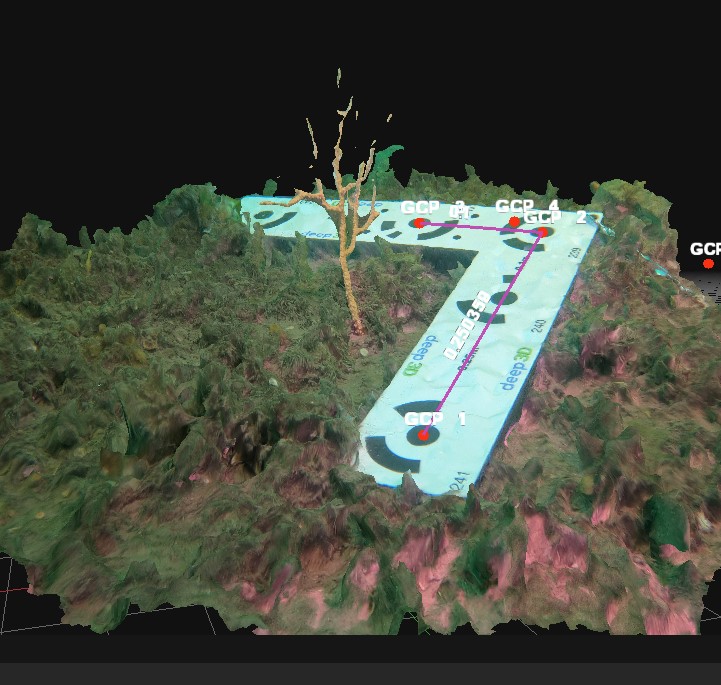
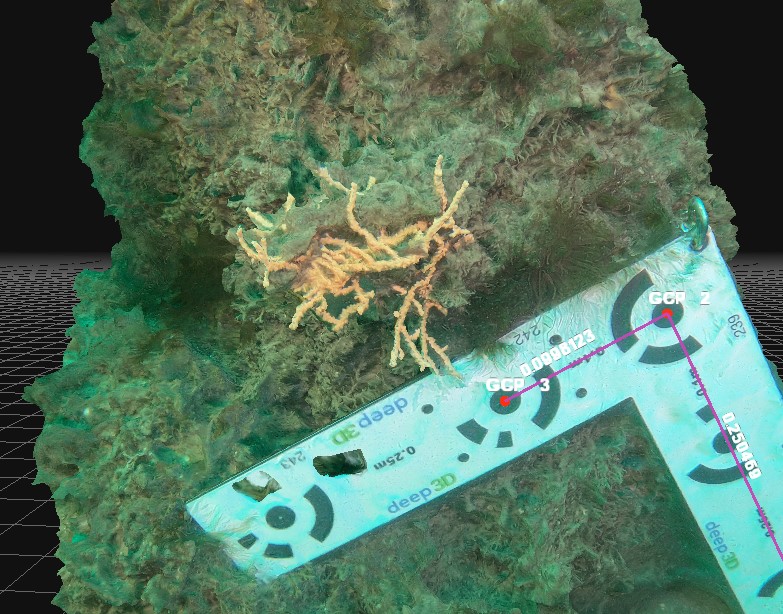
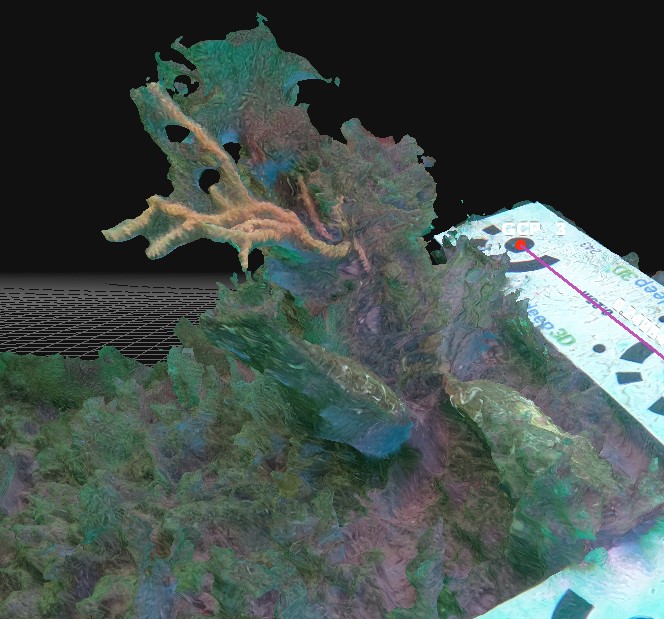
Linear Dimensions
Results from the Underwater Sea fan Photogrammetry Survey suggest strong potential for citizen science diving projects. Additionally, the table below shows the measured width and height results from the Underwater Sea fan Photogrammetry Survey.
| Model | Images | Align % | Comments on Underwater Sea fan Photogrammetry Survey | Width (cm) | Height (cm) | Total Area (cm²) | Healthy Area by Colour Crop (cm²) | % Health |
|---|---|---|---|---|---|---|---|---|
| 1 | 42 | 100 | Incomplete elements. Volume may be inaccurate. | 11 | 17 | 60 | 46 | 76% |
| 2 | 63 | 100 | One spiral turn. Some webbing. Small healthy element of large overgrown fan. | 21 | 19 | 76 | 69 | 91% |
| 3 | 87 | 100 | Good model with minimal webbing. Possible confusing colour overgrowth. | 29 | 15 | 67 | 8 | 12% |
| 4 | 35 | 100 | Fallen sea fan. | 19 | 10 | Fallen | ||
| 5 | 51 | 100 | Multiple sea fans found in model. One additional smaller fan. One large overgrown fan. | 18 | 9 | 32 | 4 | 12% |
| 6 | 62 | 100 | Minimal webbing. Very 3D sea fan, making width difficult to determine. | 21 | 8 and 4 | 31 | 4 | 12% |
| 7 | 55 | 100 | Two fronds. Good model with limited webbing. | 13 | 14 | 102 | 34 | 33% |
| 8 | 42 | 100 | Very pleasing model. Difficult to separate fan from environment, which may distort health assessment. | 26 | 17 | 36 | 13 | 36%* |
| 9 | 59 | 100 | Good definition. | 18 | 27 | 71 | 69 | 97% |
| 10 | 37 | 100 | One of the nicest models. Potential demonstrated. | 14 | 12 | 148 | 135 | 91% |
| 11 | 47 | 100 | A bundle of sea fans. | Many | Many |
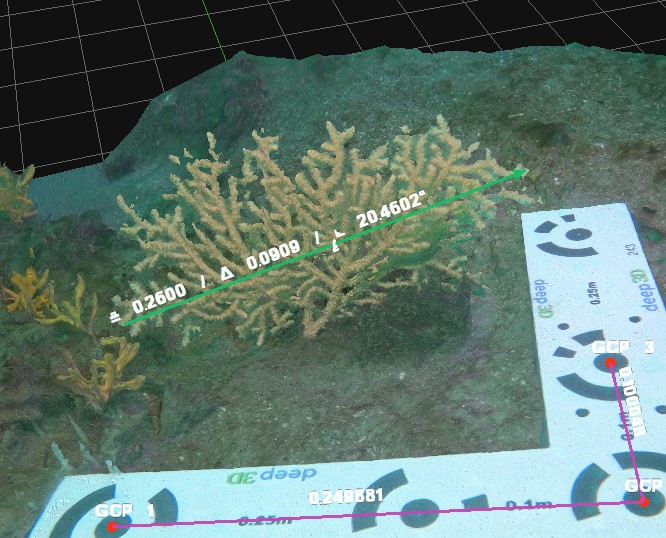
Bringing Data to life for Marine Citizen Science
With a bit of animation, twirling the sea fans around allows us a whole new post dive perspective. The important revelation from this is that additional features can be seen – these may have been missed during a diver survey without photos, relying only on diver memory. There’s a couple of features in this video – a smaller sea fan branch, and possibly an older branch that is now serving the environment as an anchor for dogfish eggs.
Underwater Photogrammetry Survey Workflow
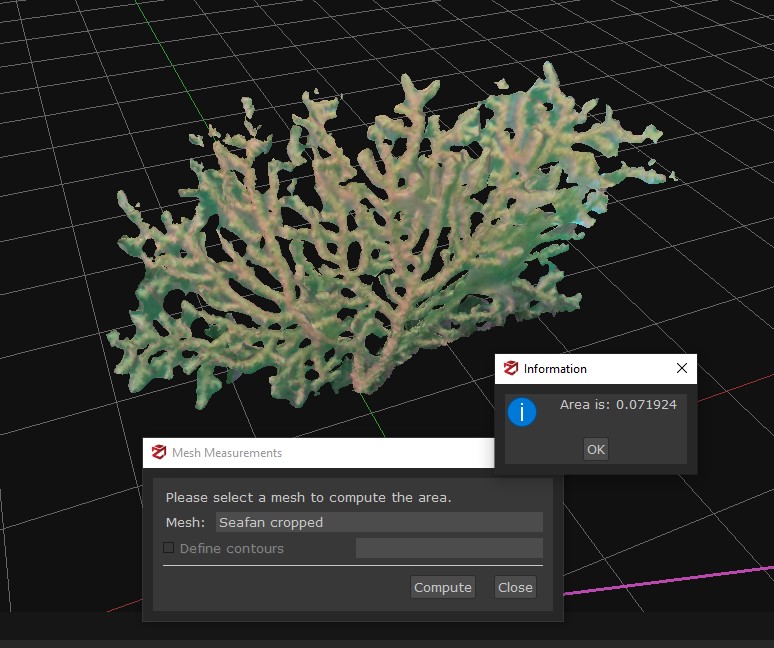
In summary, change of plan – area, not volume. The volume calculation seemed great, but was trickier. The defining of a volume requires removal of the selection from the surrounding seabed. That leaves an open ‘hole’ in the base of the sea fan model (remember 3D models are skins, not solids). Therefore, at best, this was time consuming to fill and at worst yielded weird volume extensions.
However, selecting based on pixel colour was worse – these are fragments of the model (by definition) that really don’t ‘know’ how to resolve the volume into a closed shape
That isn’t consistent, so I opted to look at area instead for the underwater sea fan photogrammetry survey. This was a much more straightforward technique and therefore more suitable for citizen science as it requires less hassle and technical tweakery.
Survey Findings
That’s these models giving all the traditional parameters, with one min of video, no touching, but with a 3D bonus view for non diving scientists to also use back at home.
However, that’s the plus side. So, what’s the drawback? Consequently, there’s no doubt that getting good models with minimal / zero webbing requires a solid photogram technique, good lighting and good buoyancy control. I’ve upgraded my lights since this exercise with a jump in quality.
Final Thoughts on Underwater Reef Documentation and Citizen Science
It would be important to practice before heading out on a dive for the first time – maybe try a leafless branch, or a garden rake end – one of the springy moss ones. Positioning around rocks can be tricky to get that final view that completes the picture. Good even lighting is essential to photogrammetry, but the arm and light position for these small targets needs careful setup. In fact, perhaps a mirror to check your six for pesky seals!
I reckon this is worth a bit more work – the initial dive has yielded some interesting results, but it needs a longer project to be fully sure. If this Underwater Sea fan Photogrammetry Survey has inspired you, consider trying underwater photogrammetry yourself and contributing to a marine survey project. Using these skills while diving is very rewarding and you will be contributing valuable data to our knowledge of our environment, with a modern, more precise method.
Conclusions on Citizen Science Survey
Overall, this Underwater Sea fan Photogrammetry Survey demonstrates how diver led marine photogrammetry can support more precise reef monitoring, citizen science, and long term underwater habitat documentation. Furthermore, it fits in really nicely with a reef survey by Matt Doggett at Long Ledges in Dorset – that focussed on the reef morphology and sea fan positions to enable return for repeat survey. This example from Lundy compliments that with more detail on the individual colonies
In conclusion, if anyone fancies a more in depth chat about these insights, I’m keen to swap ideas and take input on improving.
Cheers, Tim
1 thought on “Sea Fan Monitoring with Underwater Photogrammetry: Team BioClutter”